
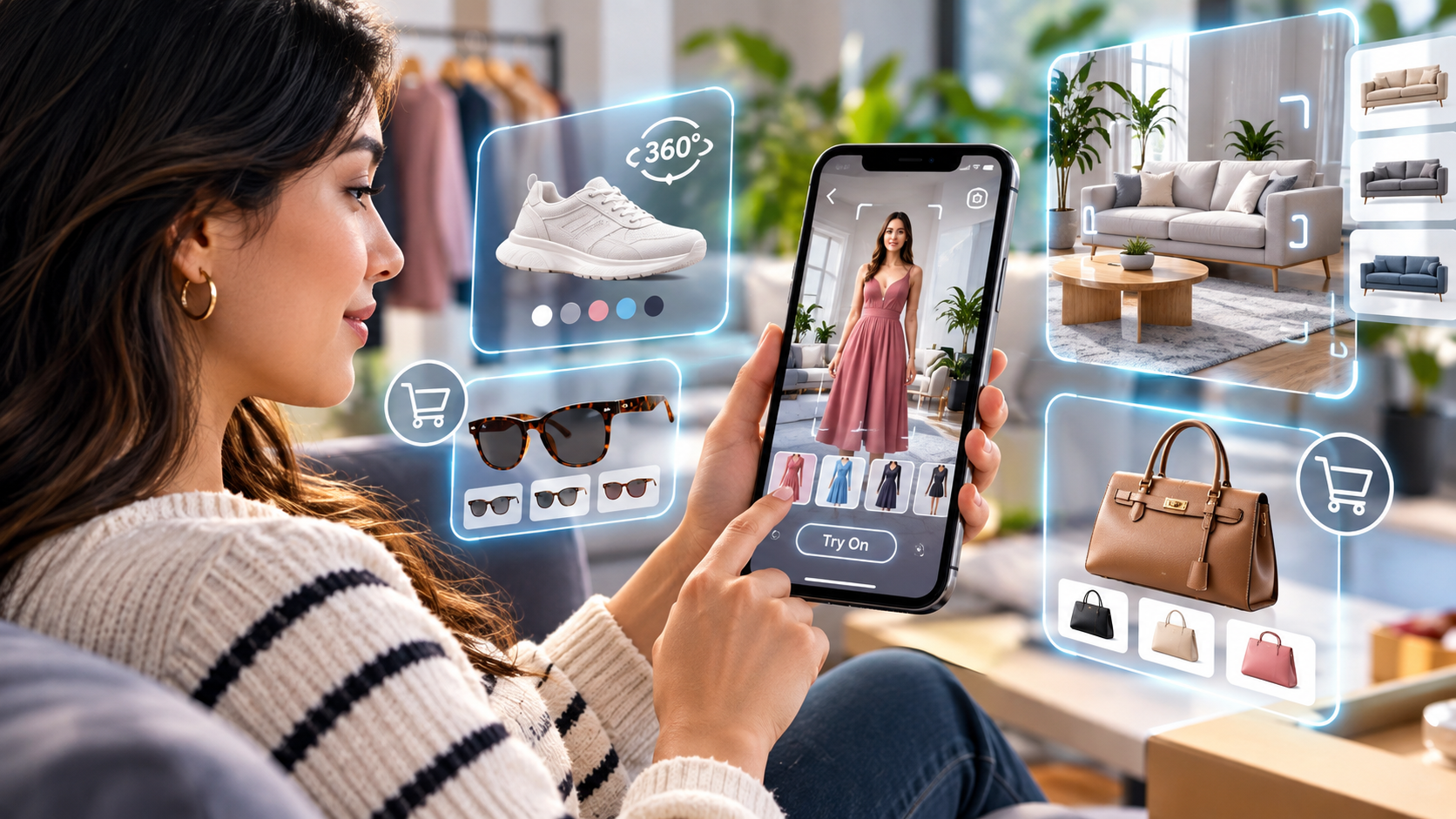
Today, online shopping has rapidly evolved into the primary method for consumers to purchase everyday goods and premium services. The unparalleled convenience of browsing through an infinite catalog of products from home has fueled an e-commerce boom. However, despite its speed and logistical efficiency, digital retail has historically suffered from one unavoidable limitation compared to traditional brick-and-mortar storefronts: the complete inability for the consumer to physically touch, feel, and try a product before committing to the purchase. This fundamental gap in the consumer journey is precisely where Augmented Reality (AR) enters the picture. AR is actively revolutionizing the digital retail landscape by seamlessly merging the physical and digital worlds, providing shoppers with immersive, interactive, and realistic purchasing experiences directly through their everyday mobile devices.
The Rise of Augmented Reality in Online Shopping
While the technology behind augmented reality has been steadily gaining traction across various sectors—most notably in mobile gaming, advanced healthcare diagnostics, and interactive education—one of its most practical applications lies firmly within the realm of digital retail. By utilizing advanced smartphone cameras and spatial mapping algorithms, AR overlays digital assets onto the user’s real-world physical environment. This technological leap effectively bridges the frustrating gap between static online web pages and physical reality. Forward-thinking brands are aggressively adopting this technology not simply as a marketing gimmick, but as a critical tool that allows prospective buyers to dynamically interact with 3D products as if they were actually sitting right in front of them.
How AR Transforms the Online Shopping Experience
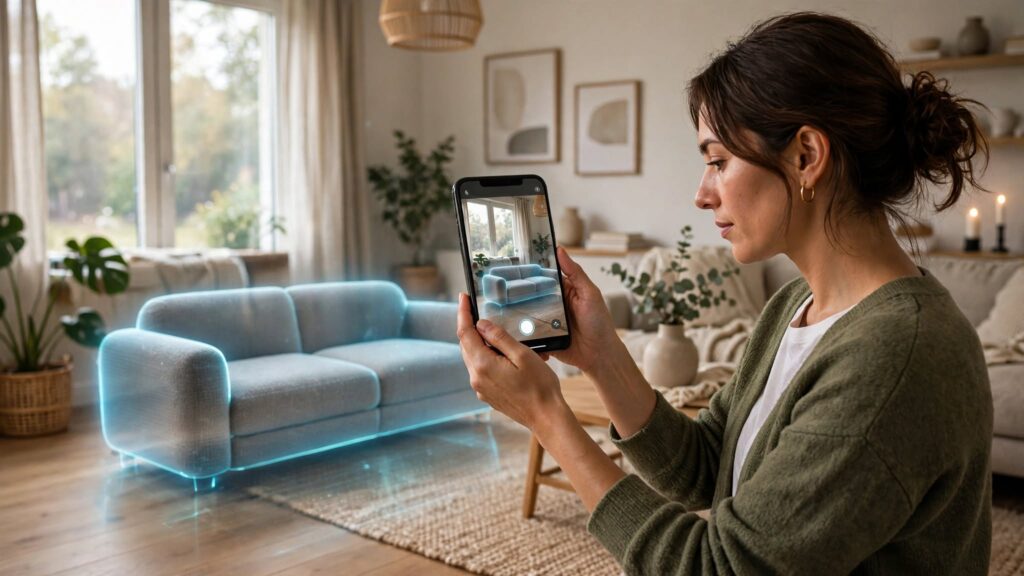
The integration of spatial computing into e-commerce is fundamentally altering how consumers research, evaluate, and ultimately purchase items on the internet. Here are the most prominent ways this technology is reshaping the modern digital storefront.
Virtual Try-Ons
One of the most exciting applications of augmented reality in digital retail is the advent of sophisticated virtual try-on technology. By leveraging AR-enabled mobile applications, consumers can instantly see exactly how specific clothing items, designer eyewear, luxury watches, or makeup palettes will look directly on their own bodies or faces before they click the checkout button. This powerful feature eliminates the guesswork associated with online fashion and beauty shopping. Not only does this deeply immersive visual confirmation drastically enhance the shopping experience, but it also significantly reduces the likelihood of costly product returns. Consumers are empowered to make far more accurate, informed, and confident decisions about their personal style purchases.
Interactive Product Visualization
For decades, digital shoppers have been forced to rely on a handful of static, two-dimensional photographs to evaluate highly complex products. AR empowers modern retailers to generate interactive, high-fidelity 3D models of their entire inventory, providing potential buyers with a more detailed visual examination of what they are purchasing. Whether a consumer is evaluating a high-end espresso machine, a premium leather handbag, or home decor pieces, augmented reality allows them to freely rotate the item, zoom in on microscopic details, and explore the product from every conceivable angle. This level of interactive engagement provides a rich, tactile sense of the product’s physical texture and build quality that a standard flat image simply cannot replicate.
Spatial Awareness and Room Mapping
Perhaps the most practical immediate benefit of AR in the e-commerce sector is its ability to provide accurate spatial awareness, which is absolutely vital for the furniture and home improvement industries. By utilizing the advanced depth-sensing cameras on modern smartphones, shoppers can accurately visualize how large, expensive products will physically fit within their specific real-world environments. Whether a homeowner is trying out three different sectional couch arrangements in their living room to check walking clearance, or previewing how a massive piece of abstract art will look hanging on their bedroom wall, AR completely eliminates the stressful “will it fit?” dilemma. It empowers consumers to confirm dimensions, color harmony, and spatial flow before dealing with difficult freight deliveries.
Personalized Recommendations
When augmented reality is seamlessly combined with advanced artificial intelligence, retailers can provide hyper-personalized product recommendations that go far beyond standard algorithms. By safely analyzing how a user interacts with digital models, or by utilizing facial mapping during a virtual try-on session, the underlying software can intelligently suggest tailored alternatives. For example, if a virtual try-on app detects that a certain style of sunglasses does not flatter a user’s specific face shape, it can instantly recommend three different frame styles that are mathematically proven to suit them better. This individualized guidance ensures recommendations resonate with the buyer, ultimately boosting customer satisfaction and driving increased conversion rates for the retailer.
Social Sharing and Community Engagement
Shopping has always fundamentally been a deeply social activity, and augmented reality effortlessly brings that collaborative dynamic directly into the isolated world of online e-commerce. With modern AR integrations, the purchasing journey becomes a highly interactive, community-driven experience. Consumers can easily capture high-quality photos or short videos of their virtual try-on sessions and instantly share them with friends, family, and followers across various social media platforms. By soliciting real-time feedback and opinions before finalizing a purchase, shoppers recreate the mall experience digitally. Furthermore, this organic social sharing adds a highly entertaining element to the buying process while simultaneously helping retailers massively expand their brand visibility and reach a much wider audience through user-generated content.
Conclusion
Augmented reality is revolutionizing the entire digital shopping ecosystem by successfully providing modern consumers with deeply immersive, interactive, and personalized experiences that effortlessly bridge the frustrating gap between the digital and physical worlds. From remarkably accurate virtual try-ons and detailed interactive product visualization to AI-driven personalized recommendations and organic social sharing, AR offers a seemingly endless array of powerful opportunities for retailers to drastically enhance the way the world shops online. As this foundational spatial technology continues to rapidly evolve and become natively accessible on a wider range of consumer devices, we can confidently expect to see even more groundbreaking applications that will permanently transform digital retail into a truly immersive, interactive reality.
Frequently Asked Questions (FAQs)
Q1. Is augmented reality shopping available on all smartphones and devices?
Ans. While augmented reality technology is rapidly becoming a standard feature across the digital landscape, not all older mobile devices have the processing power to support it. Typically, newer generation smartphones and modern tablets equipped with advanced camera sensors, depth-mapping capabilities, and updated operating systems are required to handle smooth, high-fidelity AR applications.
Q2. How physically accurate are these virtual try-on experiences?
Ans. The overall accuracy of a virtual try-on experience can vary based on several real-world factors, including ambient lighting conditions in your room, the quality of your device’s camera, and the underlying sophistication of the retailer’s software. However, massive recent advancements in spatial computing have significantly improved the scaling, shadowing, and realism of these digital overlays in recent years.
Q3. Are there any valid privacy concerns related to using AR in online shopping?
Ans. Yes, as with any emerging technology that actively accesses your camera and processes spatial or facial data, there are valid privacy concerns. Reputable retailers must remain completely transparent about how they collect, utilize, and immediately discard environmental or facial mapping data, and they must implement robust security protocols to protect consumer privacy.
Q4. Can AR technology actually help reduce the massive rate of returns in online shopping?
Ans. Absolutely. AR technology is proven to dramatically reduce return rates in the e-commerce sector by providing shoppers with highly accurate, realistic representations of physical products before they ever finalize a purchase. By allowing buyers to virtually test clothing fits or accurately visualize furniture scaling in their own living rooms, AR successfully manages expectations and eliminates costly buyer’s remorse.
Q5. Exactly how are major retailers integrating AR into their existing online shopping platforms?
Ans. Retailers are actively adopting a multi-channel approach to AR integration. Many brands are building dedicated, standalone mobile applications, while others are integrating seamless WebAR features directly into their mobile websites, requiring no downloads at all. Additionally, countless brands are launching highly viral AR try-on filters directly within popular social media platforms, providing consumers with multiple, easily accessible touchpoints.